Convert Shopify to a Mobile App in 2026 (Without a $149/mo Builder)

WebToApp Team
Product
You already run a Shopify store. Products, collections, maybe Shop Pay and a theme you tuned for mobile. What you want next is a real Android and iOS app on Google Play and the App Store — not another mobile browser tab, and not another $149/month subscription on top of Shopify.
Search for convert shopify to mobile app and you will mostly see Tapcart-class builders: native cart screens, Shopify API sync, and monthly plans that never stop. That is the right product for some merchants. It is not the only honest answer.
This guide covers the path most Shopify owners overlook: wrap your live Online Store URL in a native shell, try a free demo first, then download store-ready AAB and IPA files you submit with your own developer accounts. Pay once. No Shopify app install required. Your catalog updates when you edit Shopify — no store resubmit for product changes.
- Brand is WebToApp.app — not WebsiteToApp.app, Appy Pie, or Median.co (different products, different pricing models).
- Free Android and iOS demo at 0 credits before you pay.
- Pay-once production: Android $39, iOS $59, both $89. Add-ons (OneSignal, FCM, AdMob) $9 once per app.
- Credits charge only if production succeeds. Failed builds auto-refund.
- You submit with your own Play ($25 one-time) and Apple Developer ($99/year) accounts. No store-approval guarantee — Apple Guideline 4.2 and Play policy still apply.
Try your Shopify URL before buying credits
Paste https://your-store.com at signup, open the free demo, and walk product pages and checkout the way a reviewer will. Start here: https://www.webtoapp.app/signup · Pricing: https://www.webtoapp.app/pricing
#Three ways to turn Shopify into an app (and when each wins)
Shopify merchants usually pick one of three architectures. Mixing them up is how people buy the wrong thing — or pay monthly for native UX they never needed.
- Shopify-native app builders (Tapcart / Shopney / Vajro-class) — sync products and collections through Shopify APIs, rebuild product detail and cart in native UI, deep integrations with Shopify apps, abandoned-cart push, and merchandising tools. Monthly subscription, often $149+/mo at entry tiers that move with plan and GMV. Best when mobile conversion is a core channel and you want native PDP/cart UX plus Shopify app ecosystem features.
- Custom React Native / Flutter — agency territory. Full control, highest cost and timeline. Best when the app is a separate product with features Shopify themes cannot carry.
- URL wrapper (WebToApp.app) — your live Online Store inside a native splash, WebView, optional push, branded offline retry. Outputs signed AAB + APK and IPA. Content and checkout update on Shopify without a store resubmit; icon, splash, name, and add-ons need a rebuild.
Generic website-to-app tools (Appy Pie, WebsiteToApp.app, Median.co) also wrap URLs. WebToApp.app is built for store publishing: free logged-in demo, pay-once credits, AAB/IPA output, optional OneSignal/FCM, credits only on successful production. Always compare live pricing and what each tool actually ships — demo quality, file types, and who owns the store listing.
#When a Shopify URL wrapper is enough — and when you need a native builder
#A wrapper fits when…
- Your Online Store theme is already responsive — collections, PDP, cart, and checkout work on a phone in Safari or Chrome.
- Web checkout (Shop Pay, cards, wallets) is acceptable inside the app — you are not trying to rebuild a native cart from scratch.
- You want Play and/or App Store discovery, a home-screen icon, and optional native push for drops and campaigns.
- Editors should keep working in Shopify Admin. Product photos, prices, and inventory sync automatically because the app loads the live storefront.
- You would rather pay once ($39 / $59 / $89) than $149+/mo indefinitely for a builder you may outgrow.
#Reach for a Tapcart-class builder when…
- Native product detail and cart UX is non-negotiable — swipe galleries, native add-to-cart animations, wishlists built for thumbs.
- You rely on deep Shopify app integrations that expect a native commerce shell (loyalty, subscriptions UI, advanced merchandising).
- Abandoned-cart and lifecycle automation through the builder's native stack is central to your retention playbook.
- Monthly spend is budgeted because mobile is a primary revenue channel, not a nice-to-have listing.
Honest middle ground: many merchants start with a wrapper to validate store-listing demand, then graduate to a native builder if conversion data justifies the subscription. Others never need to — a fast theme plus push is enough.
#Shopify pre-flight checklist (fix these before production credits)
Most failed app launches are storefront problems wearing an app icon. Run this on your live domain — not the admin preview — before you spend credits.
- HTTPS on a custom domain. myshopify.com works for testing; stores usually ship with the domain customers recognize.
- Mobile-responsive Online Store theme. Test collection grids, product pages, cart drawer, and navigation at phone width on real iOS Safari and Android Chrome.
- Checkout and Shop Pay at phone width. Complete a test order in the free demo. Payment redirects and 3-D Secure must finish inside the WebView.
- Cookie / consent banners must not permanently cover product images or block Add to cart taps.
- Privacy policy URL that matches what you collect (Shopify checkout, analytics, email/SMS apps). Link it in store settings and App Store Connect / Play listing.
- 1024×1024 PNG app icon ready for store builds (no alpha for Apple). Favicon is enough for the free demo only.
- Real catalog depth. A handful of placeholder SKUs and a thin landing page fail Apple Guideline 4.2 (minimum functionality) and Play spam / minimum-functionality policy.
Password-protected or wholesale-only stores
If the storefront is behind a password or login wall, provide demo credentials in Play Console and App Store Connect review notes. Reviewers will not create wholesale accounts for you.
#Checkout honesty: Shopify Checkout inside a WebView
WebToApp.app loads your public storefront URL. When a customer taps Buy, they go through the same Shopify Checkout your mobile web shoppers use — Shop Pay, cards, Apple Pay on web where Shopify enables it. That is usually what Shopify merchants want: one inventory, one order admin, no duplicate catalog sync.
- Physical goods and typical DTC checkout: wrapper + Shopify Checkout is a common, honest pattern. Test tax, shipping, discounts, and gift cards in the free demo.
- Digital goods, subscriptions, or content sold inside the iOS app may trigger Apple Guideline 3.1 (In-App Purchase). Wrapping a web checkout does not automatically exempt you. Read Apple's rules for your product type.
- Shopify scripts, third-party checkout extensions, and post-purchase upsells: verify each step in the demo WebView. Some popups behave differently than in mobile Safari.
- No converter — WebToApp.app included — can promise Apple or Google approval. Policy compliance is yours: content, metadata, privacy labels, and checkout behavior.
Shopify plugin?
WebToApp.app does not install a Shopify app on your store. Paste the public storefront URL. Native builders often require their Shopify app for API sync — different architecture, different ongoing cost.
#Convert Shopify with WebToApp.app (step by step)
#1. Sign up and open the free demo
- Create an account at https://www.webtoapp.app/signup.
- Create an app and paste your Shopify storefront HTTPS URL (your custom domain or myshopify.com).
- We fetch favicon and title when we can. Replace both before store builds.
- On General, tap Open demo. Android and iOS demo builds queue at 0 credits.
- Walk home, collections, a product page, cart, and checkout the way an App Review team will.
Ask one question: does this feel like shopping in an app, or like a desktop theme squeezed into a phone? If navigation, cart, or checkout fail here, fix the theme or apps before spending credits. Product tour: Getting Started with WebToApp (https://www.webtoapp.app/blog/getting-started-with-webtoapp).
#2. Branding reviewers see first
- App name: short and specific. Apple caps at 30 characters and rejects keyword stuffing.
- Icon: 1024×1024 before a store build. Play listing also wants 512×512.
- Splash: first native frame customers see — not a screenshot of Shopify Admin.
- Theme colors: match your storefront chrome (#00C09A is WebToApp.app's brand teal; use your store palette).
#3. Optional push (and why it matters for review)
A bare URL bar in a WebView is the classic Apple 4.2 failure mode. Native extras do not guarantee approval — but they are what you can point at in review notes.
- OneSignal or FCM push — $9 once per app. Strong for drop alerts, back-in-stock, and campaign sends. Setup: OneSignal guide (https://www.webtoapp.app/blog/push-notifications-onesignal-guide).
- Branded offline retry — built into the shell. Reviewers airplane-mode test. It is not an offline catalog mirror.
- AdMob — $9 once, only if ads already belong on the site. Do not bolt ads onto a thin storefront.
Push is a 4.2 lever, not a guarantee
Icon plus splash alone rarely satisfy Guideline 4.2. Push, offline retry, and app-like chrome (no browser URL bar) help — but your Shopify catalog still has to be a real product. Full store checklist: How to Publish Your Website on Google Play and the App Store in 2026 (https://www.webtoapp.app/blog/publish-website-to-google-play-app-store-2026).
#4. Production build — when credits charge
When the demo looks right, run Production on Android and/or iOS. Credits move only if that production build succeeds. Failed production refunds automatically. Demo files stay free and are not store binaries.
- Android: first build 39 credits ($39), rebuilds $9. Signed AAB for Play plus APK for device testing.
- iOS: first build 59 credits ($59), rebuilds $19. IPA for TestFlight / App Store Connect.
- Both-platforms pack: $89 when you know you will ship both stores.
#What happens after you download AAB and IPA
WebToApp.app does not submit on your behalf. You upload with your own Google Play and Apple Developer accounts — that matches Apple Guideline 4.2.6 expectations that the content owner submits.
- Google Play: upload the AAB (not the APK) to a testing track. Personal accounts created after 13 Nov 2023 usually need closed testing — 12 testers opted in continuously for 14 days — before production access (https://support.google.com/googleplay/android-developer/answer/14151465).
- Apple: upload the IPA, complete listing and privacy nutrition labels, TestFlight, then App Review. Guideline 4.2 rejects thin URL-only shells (https://developer.apple.com/app-store/review/guidelines/#minimum-functionality).
- WordPress and WooCommerce owners: parallel caveats in the WordPress guide (https://www.webtoapp.app/blog/convert-wordpress-to-mobile-app). Squarespace owners: https://www.webtoapp.app/blog/convert-squarespace-to-mobile-app.
No store-approval guarantee
We generate signed binaries, a native shell with optional push and offline retry, and a free demo. Policy compliance is yours — catalog depth, metadata, Play Data safety, App Privacy details, and checkout behavior. FAQ: https://www.webtoapp.app/faq
#Year-one cost: WebToApp.app vs Shopify-native builders
- WebToApp.app Android only: $39 + $25 Play = $64, or $73 with push add-on.
- WebToApp.app both stores: $89 + $25 Play + $99 Apple = $213, or $222 with push.
- WebToApp.app iOS only: $59 + $99 Apple = $158.
- Year two: Apple $99 if you keep iOS. WebToApp.app $0 unless you rebuild ($9 Android / $19 iOS) or add another add-on.
- Shopify-native builder class (Tapcart / Shopney / Vajro-style): often $149–$499+/mo depending on plan, GMV tier, and features — roughly $1,788–$5,988+ in year one before your Shopify plan. Treat as a range, not an invoice.
- Product and theme edits go live without a store resubmit. Rebuild the shell only when icon, splash, name, or add-ons change.
The tradeoff is UX and integrations, not magic. Native builders buy native cart polish and Shopify app depth. WebToApp.app buys store listings and push at pay-once economics when your responsive Online Store is already good enough.
#FAQ
#Do I need a Shopify app or plugin for WebToApp.app?
No. Paste your public storefront URL. Native builders typically install a Shopify app for API sync — that is a different product category.
#Will my theme customizer changes show up in the app?
Yes — the app loads your live Online Store. Theme edits, new products, and price changes appear immediately. Rebuild only when the native shell changes (icon, splash, app name, push keys, etc.).
#Do I need a new store release when I add products?
No. Inventory and merchandising stay in Shopify Admin as today. Store resubmit is for binary or listing changes — not for routine catalog updates.
#Do I need Android Studio or a Mac?
Not to generate AAB/IPA with WebToApp.app. You still need Play Console ($25) and, for iOS, Apple Developer Program ($99/year). A Mac is optional if you prefer Xcode or Transporter for upload.
#How is WebToApp.app different from WebsiteToApp.app, Appy Pie, or Median?
All can wrap URLs. WebToApp.app focuses on store-ready output: free logged-in demo at 0 credits, pay-once production credits, signed AAB and IPA, optional OneSignal/FCM, and credits charged only on successful builds. Compare demo quality, pricing model (subscription vs pay-once), and who submits to the stores before you buy.
#Should I skip native builders entirely?
Not if you need native cart UX, deep Shopify app integrations, or builder-owned automation that assumes a native commerce stack. If your responsive storefront plus push is enough, a wrapper saves thousands in year one.
Start with the free Shopify demo
Paste your storefront URL and open Android + iOS demo at 0 credits (https://www.webtoapp.app/signup). If shopping feels right, buy credits only for a successful production build — $39 / $59 / $89 (https://www.webtoapp.app/pricing). Then follow the 2026 store publish checklist (https://www.webtoapp.app/blog/publish-website-to-google-play-app-store-2026). Pay once. No approval guarantee.
Related Articles
 Tutorials
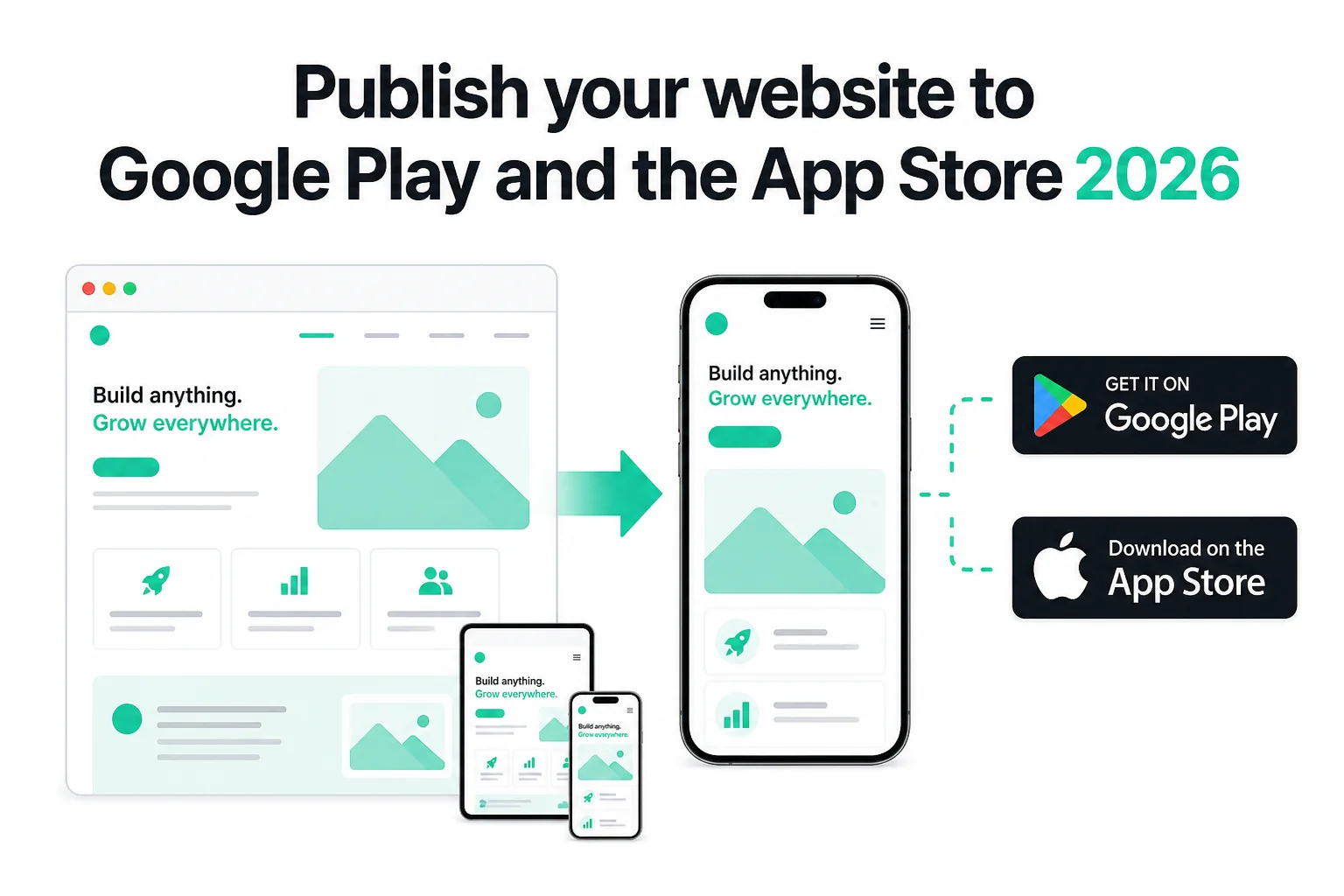
How to Publish Your Website on Google Play and the App Store in 2026 (No Code)
Publish your existing website as Android and iOS apps in 2026 — no Android Studio or Xcode. Get store-ready AAB and IPA files, pass Play closed testing and Apple 4.2, and only pay if the production build succeeds.
WebToApp Team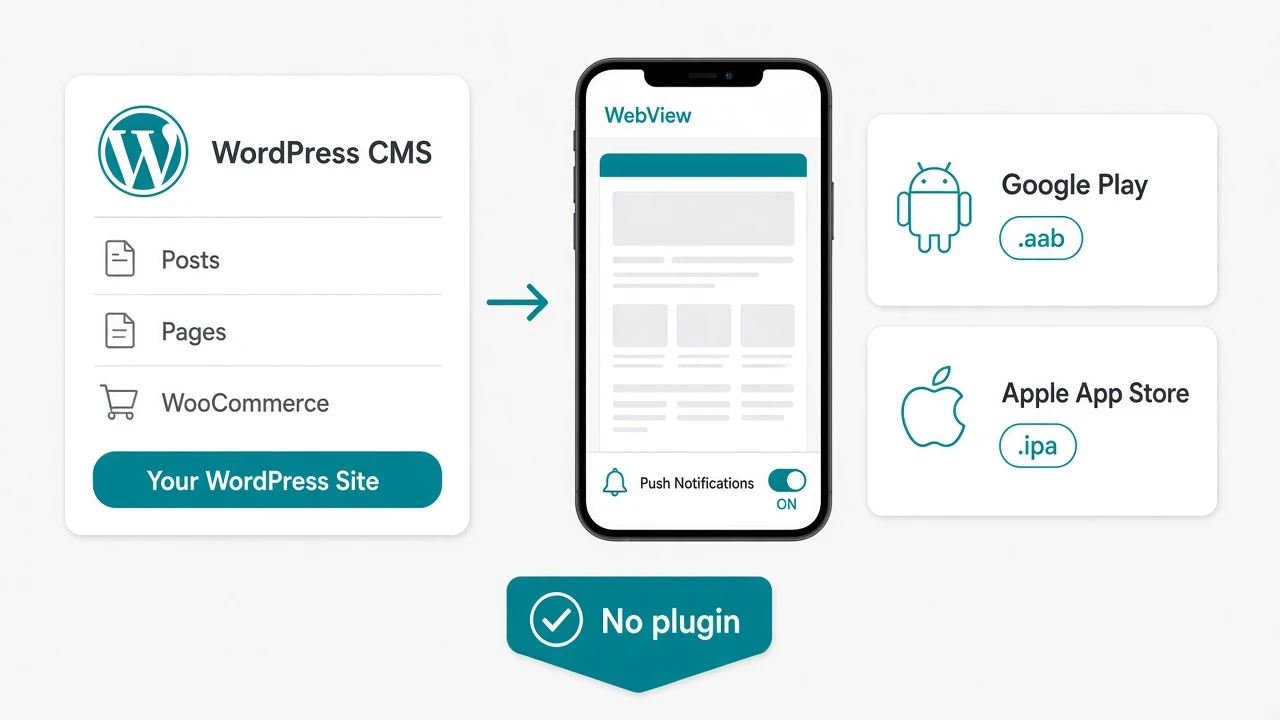 Tutorials
Convert WordPress to a Mobile App in 2026 (No Plugin, Both Stores)
Turn your WordPress site into Android and iOS apps without a WordPress plugin or React Native rewrite. Free demo of your live URL, pay-once credits for store-ready AAB and IPA, own Play and App Store accounts.
WebToApp Team Tutorials
Getting Started with WebToApp: Convert Your Website to a Mobile App in Minutes
Learn how to transform your existing website into native iOS and Android apps using WebToApp. No coding required—just enter your URL and build.
WebToApp Team