Convert Lovable to a Mobile App in 2026 (No React Native Rebuild)

WebToApp Team
Product
Lovable ships real React web apps — dashboards, auth, Supabase backends, vibe-coded UI — and publishes them to HTTPS URLs you can open in any browser. That is not the same thing as an Android App Bundle or an IPA on Google Play and the App Store. Lovable’s own mobile editor and companion experiences help you design and preview; they do not automatically publish your project as store binaries under your developer accounts.
Search convert lovable to mobile app and you will see the same fork: rebuild in React Native or Flutter, subscribe to a Median-class website wrapper, wire up Capacitor yourself, or wrap the live published URL. Some paths are right for a product that needs native navigation and offline-first data. Many Lovable projects only need a store listing, home-screen icon, and optional push — when the published site already works on a phone.
This guide is the pay-once URL-wrapper path: paste your Lovable published URL, open a free demo at 0 credits, then download signed AAB and IPA files you submit with your own Play Console and Apple Developer accounts. No React Native rebuild. No plugin inside Lovable. Deploys on the live URL keep updating the app without a store resubmit.
- Brand is WebToApp.app — not WebsiteToApp.app, Appy Pie, Median, or AppOfWeb (different products, different pricing models).
- Free Android and iOS demo at 0 credits before you pay.
- Pay-once production: Android $39, iOS $59, both $89. Add-ons (OneSignal, FCM, AdMob) $9 once per app.
- Credits charge only if production succeeds. Failed builds auto-refund.
- You submit with your own Play ($25 one-time) and Apple Developer ($99/year) accounts. No store-approval guarantee — Apple Guideline 4.2 and Play policy still apply.
Try your published URL before buying credits
Paste your live HTTPS URL (custom domain preferred over a default *.lovable.app subdomain for production) at signup, open the free demo, and walk auth, forms, and checkout the way a reviewer will. Start here: https://www.webtoapp.app/signup · Pricing: https://www.webtoapp.app/pricing
#Four ways to get a Lovable project onto phones (and when each wins)
Lovable builders usually land on one of four architectures. Picking the wrong one is how teams pay monthly wrapper fees for a brochure app — or ship a thin WebView shell when the product needed a true native rebuild.
- Stay a PWA — add to Home Screen, service worker, install prompts in Chrome. Free and fast. You do not get a Play or App Store listing, and iOS PWA limits still bite push and discovery. Good for internal tools; weak when marketing wants store badges.
- DIY Capacitor (or Cordova-class) — wrap your built web assets in a native project, open Android Studio and Xcode, manage plugins and signing yourself. Full control, real dev time, and you own every breakage when auth, CSP, or third-party scripts misbehave in WebView.
- Subscription / license wrappers (Median-class and similar) — wrap the live site, add bridge plugins, pay activation plus annual renewals. Best when you want their plugin catalog and ongoing platform support; budget for recurring fees on top of store accounts. Compare live vendor pricing — we do not quote exact Median dollars here because tiers move.
- Pay-once URL wrapper (WebToApp.app) — your live published HTTPS URL inside a native splash, WebView, optional push, branded offline retry. Outputs signed AAB + APK and IPA. Content updates on deploy without a store resubmit; icon, splash, name, and add-ons need a rebuild.
Deeper read on wrapper vs installable web: PWA vs Native Website Wrapper for App Stores in 2026 (https://www.webtoapp.app/blog/pwa-vs-native-wrapper-website-to-app-2026). Sibling platform guide with similar economics: Convert Webflow to a Mobile App (https://www.webtoapp.app/blog/convert-webflow-to-mobile-app).
#When a Lovable URL wrapper is enough — and when you need Capacitor DIY or a rebuild
#A URL wrapper fits when…
- Your published app is already responsive — nav, forms, tables, and auth flows work at phone width in Safari and Chrome.
- Supabase, edge functions, and APIs stay on the server; the mobile shell loads your HTTPS UI like a focused browser without a URL bar.
- You want Play and/or App Store discovery, a home-screen icon, and optional native push for launches and re-engagement.
- You ship updates by publishing on Lovable; editors should not resubmit to Apple and Google for every copy tweak.
- You would rather pay once ($39 / $59 / $89) than carry subscription wrapper licenses forever for a site that is already the product.
#Reach for Capacitor DIY or a native rebuild when…
- Core UX depends on native navigation, gesture-heavy UI, or offline-first local data that a WebView cannot honestly deliver.
- You need deep hardware access (Bluetooth, background location, advanced camera pipelines) as the primary reason users install.
- Digital goods sold inside the iOS app require a first-class In-App Purchase implementation — a thin wrapper around web checkout is a Guideline 3.1 risk.
- You are building a separate native product that only shares branding with a Lovable marketing site — not the Lovable app itself as the store listing.
Honest middle ground: wrap the live Lovable URL first to validate store demand and retention, then invest in Capacitor or native if metrics justify it. Many vibe-coded MVPs never need step two.
#Lovable-specific gotchas before you spend credits
- Published HTTPS URL — production listings should use a custom domain customers recognize. Default *.lovable.app subdomains are fine for demos; stores and reviewers expect stability and branding on your domain.
- Mobile-responsive UI — Lovable can look great on desktop and still break at 390px width. Fix layout in the published app before Open demo.
- Auth — Google Sign-In in a WebView is common; Apple expects Sign in with Apple when you offer other third-party login on iOS. Test the full session path in the demo, not only in desktop Chrome.
- Payments and digital goods — physical goods and external web checkout often pass review when the app is substantial. Selling digital content inside the iOS app generally requires IAP. Do not assume a wrapper fixes 3.1.
- CSP, iframes, and embeds — third-party widgets and strict Content-Security-Policy headers behave differently in in-app WebViews. Submit a real form and open embedded flows in Open demo.
- Supabase and backends stay on the web side — the wrapper does not migrate your database. API keys and RLS rules remain your responsibility; the app is a native front door to the same HTTPS origin.
#Lovable pre-flight checklist (fix these before production credits)
Most failed app launches are site problems wearing an app icon. Run this on your published URL — not only the Lovable editor preview — before you spend credits.
- Published HTTPS on a custom domain when possible. Demo on *.lovable.app; ship production on the domain users trust.
- Phone-width QA on real iOS Safari and Android Chrome — then repeat inside Open demo.
- Login and signup — include demo credentials in Play Console and App Store Connect review notes if anything is gated.
- Sign in with Apple on iOS if you offer Google or other OAuth — verify in demo before production.
- Checkout and paywalls — confirm behavior matches Apple and Google rules for your product type.
- Cookie and consent banners must not permanently cover CTAs or block taps.
- Privacy policy URL that matches analytics, auth, and forms. Link it in the app and both store listings.
- 1024×1024 PNG app icon ready for store builds (no alpha for Apple). Favicon is enough for the free demo only.
- Real content depth — a single placeholder screen fails Apple Guideline 4.2 (minimum functionality) and Play minimum-functionality policy. AI-generated UIs still need a real product behind them.
Password or member gates
Reviewers will not invent accounts for you. Put working demo credentials in review notes, or keep a public path deep enough that Guideline 4.2 does not treat the shell as empty.
#Sync honesty: live URL deploys vs shell rebuild
With WebToApp.app, the app loads your live published URL. When you deploy on Lovable — new screen, copy change, API route fix on the same origin — the next open of the app shows it. You do not resubmit to Play or Apple for routine content and backend changes that appear on that URL.
- No store resubmit: Lovable publishes, page and flow changes on the live HTTPS URL, Supabase-backed data your UI already fetches.
- Needs a rebuild (+ store update): app icon, splash, display name, OneSignal/FCM keys, AdMob, package identifiers.
- React and Vite assets: if it works in mobile Chrome/Safari on the published URL, it usually works in the WebView — still verify in Open demo. Heavy animation and some analytics scripts are the usual breakage points.
- No converter — WebToApp.app included — can promise Apple or Google approval. Policy compliance is yours: content depth, metadata, privacy labels, auth and checkout behavior.
Lovable plugin?
WebToApp.app does not install a Lovable plugin or marketplace app. Paste the public published HTTPS URL. Capacitor and subscription wrappers are separate products with their own setup and ongoing cost.
#Convert Lovable with WebToApp.app (step by step)
#1. Sign up and open the free demo
- Create an account at https://www.webtoapp.app/signup.
- Create an app and paste your published Lovable HTTPS URL (custom domain preferred).
- We fetch favicon and title when we can. Replace both before store builds.
- On General, tap Open demo. Android and iOS demo builds queue at 0 credits.
- Walk home, auth, a form, and any paid or gated path the way an App Review team will.
Ask one question: does this feel like using an app, or like a desktop canvas squeezed into a phone? If nav, auth, or forms fail here, fix the published app before spending credits. Product tour: Getting Started with WebToApp (https://www.webtoapp.app/blog/getting-started-with-webtoapp).
#2. Branding reviewers see first
- App name: short and specific. Apple caps at 30 characters and rejects keyword stuffing.
- Icon: 1024×1024 before a store build. Play listing also wants 512×512.
- Splash: first native frame customers see — not a screenshot of the Lovable editor UI.
- Theme colors: match your app chrome (#00C09A is WebToApp.app’s brand teal; use your palette).
#3. Optional push (and why it matters for review)
A bare URL bar in a WebView is the classic Apple 4.2 failure mode — especially for AI-generated or thin vibe-coded shells. Native extras do not guarantee approval — but they are what you can point at in review notes.
- OneSignal or FCM push — $9 once per app. Strong for launches, reminders, and re-engagement. Setup: OneSignal guide (https://www.webtoapp.app/blog/push-notifications-onesignal-guide).
- Branded offline retry — built into the shell. Reviewers airplane-mode test. It is not an offline clone of your Supabase data.
- AdMob — $9 once, only if ads already belong on the site. Do not bolt ads onto a thin brochure.
Push is a 4.2 lever, not a guarantee
Icon plus splash alone rarely satisfy Guideline 4.2. Push, offline retry, and app-like chrome (no browser URL bar) help — but your Lovable app still has to be a real product. Full store checklist: How to Publish Your Website on Google Play and the App Store in 2026 (https://www.webtoapp.app/blog/publish-website-to-google-play-app-store-2026).
#4. Production build — when credits charge
When the demo looks right, run Production on Android and/or iOS. Credits move only if that production build succeeds. Failed production refunds automatically. Demo files stay free and are not store binaries.
- Android: first build 39 credits ($39), rebuilds $9. Signed AAB for Play plus APK for device testing.
- iOS: first build 59 credits ($59), rebuilds $19. IPA for TestFlight / App Store Connect.
- Both-platforms pack: $89 when you know you will ship both stores.
#What happens after you download AAB and IPA
WebToApp.app does not submit on your behalf. You upload with your own Google Play and Apple Developer accounts — that matches Apple Guideline 4.2.6 expectations that the content owner submits.
- Google Play: upload the AAB (not the APK) to a testing track. Personal accounts created after 13 Nov 2023 usually need closed testing — 12 testers opted in continuously for 14 days — before production access.
- Apple: upload the IPA, complete listing and privacy nutrition labels, TestFlight, then App Review. Guideline 4.2 rejects thin URL-only shells.
- Cost context: How Much Does It Cost to Turn a Website Into an App in 2026? (https://www.webtoapp.app/blog/how-much-does-it-cost-to-turn-website-into-app-2026).
No store-approval guarantee
We generate signed binaries, a native shell with optional push and offline retry, and a free demo. Policy compliance is yours — content depth, metadata, Play Data safety, App Privacy details, auth and checkout behavior. FAQ: https://www.webtoapp.app/faq
#Year-one cost: WebToApp.app pay-once vs subscription wrappers
- WebToApp.app Android only: $39 + $25 Play = $64, or $73 with push add-on.
- WebToApp.app both stores: $89 + $25 Play + $99 Apple = $213, or $222 with push.
- WebToApp.app iOS only: $59 + $99 Apple = $158.
- Year two: Apple $99 if you keep iOS. WebToApp.app $0 unless you rebuild ($9 Android / $19 iOS) or add another add-on.
- Subscription wrapper models (Median-class and similar): platform activation and/or monthly or annual renewals on top of Apple ~$99/year and Google Play $25 one-time — compare demos and file ownership on each vendor site.
- DIY Capacitor: no platform fee to WebToApp.app, but real engineer time for Xcode, Gradle, plugins, and every store rejection you debug yourself.
- Live URL deploys go live without a store resubmit. Rebuild the shell only when icon, splash, name, or add-ons change.
The tradeoff is lock-in and services, not magic. Subscription wrappers buy ongoing bridge plugins and support. WebToApp.app buys store-ready binaries at pay-once economics when your responsive Lovable published app is already good enough.
#FAQ
#Do I need a Lovable plugin for WebToApp.app?
No. Paste your public published HTTPS URL. Capacitor projects and subscription wrappers are separate stacks with their own setup — different architecture, different ongoing cost.
#Does auth work — especially Google login and Sign in with Apple?
Often yes if login works in mobile Safari and Chrome, but OAuth redirects and cookies behave differently in WebViews. Apple requires Sign in with Apple when you offer other third-party sign-in on iOS. Test the full session in Open demo and add review credentials before production.
#What about digital goods and Apple Guideline 3.1?
Physical goods and services checkout in a WebView often pass review when the app is substantial. Digital goods sold inside the iOS app generally require In-App Purchase. A Lovable Stripe checkout page inside a wrapper is not a substitute for IAP when Apple treats your product as digital content consumed in-app.
#How is WebToApp.app different from WebsiteToApp.app, Median, or DIY Capacitor?
All can put your business on mobile. WebToApp.app focuses on store-ready output: free logged-in demo at 0 credits, pay-once production credits ($39/$59/$89), signed AAB and IPA for both stores, optional OneSignal/FCM, and credits charged only on successful builds. WebsiteToApp.app is a different brand (often Android-focused in search). Median-class tools use subscription or license models with bridge plugins. Capacitor DIY is free software but not free time. Compare demo quality, pricing model, who owns binaries, and who submits to the stores before you buy.
#Do I need Android Studio or a Mac?
Not to generate AAB/IPA with WebToApp.app. You still need Play Console ($25) and, for iOS, Apple Developer Program ($99/year). A Mac is optional if you prefer Xcode or Transporter for upload.
#Can I use a *.lovable.app subdomain or do I need a custom domain?
Subdomains work for demos and internal testing. Production store listings usually look more credible on a custom domain you control — and you are less exposed if default hosting URLs change. Point your domain at the published Lovable app, verify HTTPS, then paste that URL into WebToApp.app.
Start with the free Lovable URL demo
Paste your published HTTPS URL and open Android + iOS demo at 0 credits (https://www.webtoapp.app/signup). If it feels right, buy credits only for a successful production build — $39 / $59 / $89 (https://www.webtoapp.app/pricing). Then follow the 2026 store publish checklist (https://www.webtoapp.app/blog/publish-website-to-google-play-app-store-2026). Pay once. No approval guarantee.
Related Articles
 Tutorials
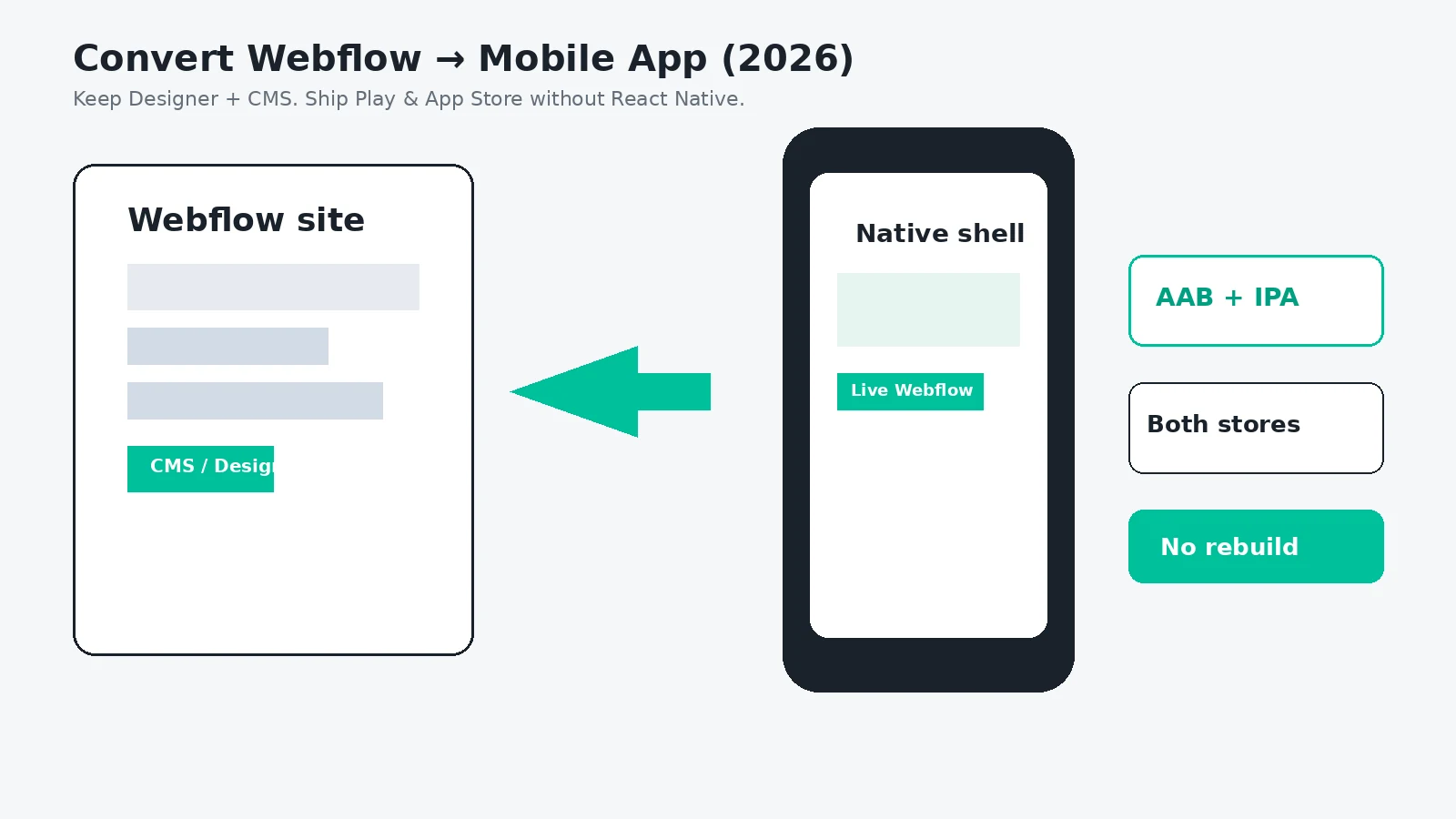
Convert Webflow to a Mobile App in 2026 (No Rebuild, Both Stores)
Turn your Webflow Designer and CMS site into Android and iOS apps without rebuilding in React Native or paying Median-class subscriptions forever. Free demo at 0 credits, pay-once AAB and IPA, your own Play and App Store accounts.
WebToApp Team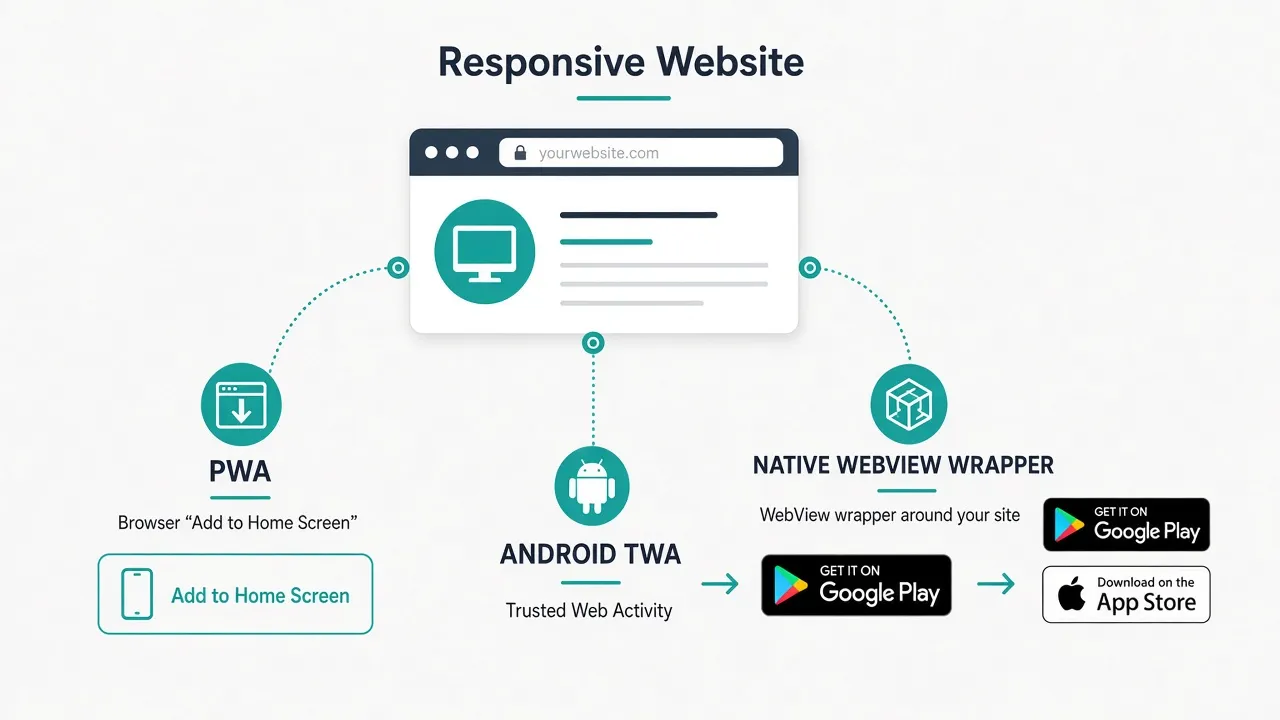 Tutorials
PWA vs Native Website Wrapper for App Stores in 2026
Honest comparison: stay on a PWA, ship Android via TWA, wrap your URL for both stores, or hire native. What iOS and Android actually allow in 2026, when each path wins, Apple 4.2 reality, and pay-once wrapper pricing.
WebToApp Team Tutorials
How Much Does It Cost to Turn a Website Into an App in 2026?
Honest year-one math for every route — DIY Capacitor, pay-once URL wrappers, subscription publishers, managed services, and native rebuilds. WebToApp.app both-platform example: about $213 first year including Apple and Play fees.
WebToApp Team